What this article answers
This guide compares pgvector (vectors inside PostgreSQL) and Pinecone (managed vector database) for RAG and semantic search in 2026. It covers architecture, performance, cost, SQL filtering advantages, scale limits, and when to choose each—based on production benchmarks and real operator tradeoffs.
Search and AI context: related phrases include pgvector vs Pinecone, PostgreSQL vector database, RAG retrieval layer, HNSW index, embedding storage, vector similarity search, managed Postgres vectors, Pinecone cost, pgvectorscale, semantic search SQL filters, and single source of truth for embeddings.
Glossary (quick definitions)
- Embedding: A numeric vector (e.g. 1,536 dimensions) representing meaning of text, image, or audio.
- Vector search: Finding nearest neighbors in embedding space (cosine, L2, or inner product distance).
- RAG: Retrieval-augmented generation—fetch relevant chunks before calling an LLM.
- pgvector: PostgreSQL extension adding
vectortype, distance operators, and indexes. - HNSW: Approximate nearest-neighbor index; fast queries with tunable recall.
- Recall: Fraction of true nearest neighbors returned by an approximate index.
- Metadata filtering: Restricting vector search by tags/fields—native SQL in pgvector, API filters in Pinecone.
The short answer
For most teams building AI applications in 2026, pgvector is the right default. If you already run PostgreSQL and you sit somewhere under roughly 10 to 50 million vectors, adding pgvector to the database you already have will beat standing up a separate vector service. You win on cost, you win on operational simplicity, and you keep your query flexibility, all while matching a hosted service on latency for the workloads most people actually run.
Pinecone earns its place in a narrower set of cases. Think hundreds of millions of vectors, sustained high query traffic, multi region replication, or a team that wants zero database operations and is happy to pay a premium to avoid them.
That is the verdict. The rest of this article walks through how to reach it for your specific situation, with benchmarks from people who have actually run these systems in production, a real cost breakdown, a decision table, and the operational details the documentation tends to skip.
Why every backend now needs vector search
If you are building anything with AI this year, you are building with vectors whether you think about it that way or not. Vector search has quietly become the layer underneath almost every AI feature people ship.
RAG systems pull relevant context from embeddings before handing it to a language model. Recommendation engines match people to content by similarity. AI agents store and recall their memory as vectors. Semantic search finds results by meaning instead of keywords. Even fraud detection leans on comparing transaction patterns in embedding space.
The money has followed. The analysts at Groovyweb, summarizing the state of the market in 2026, put the global vector database market at 3.2 billion dollars in 2025 and growing at about 24 percent a year. That pace is why the landscape shifts every quarter and every vendor is shipping features as fast as they can.
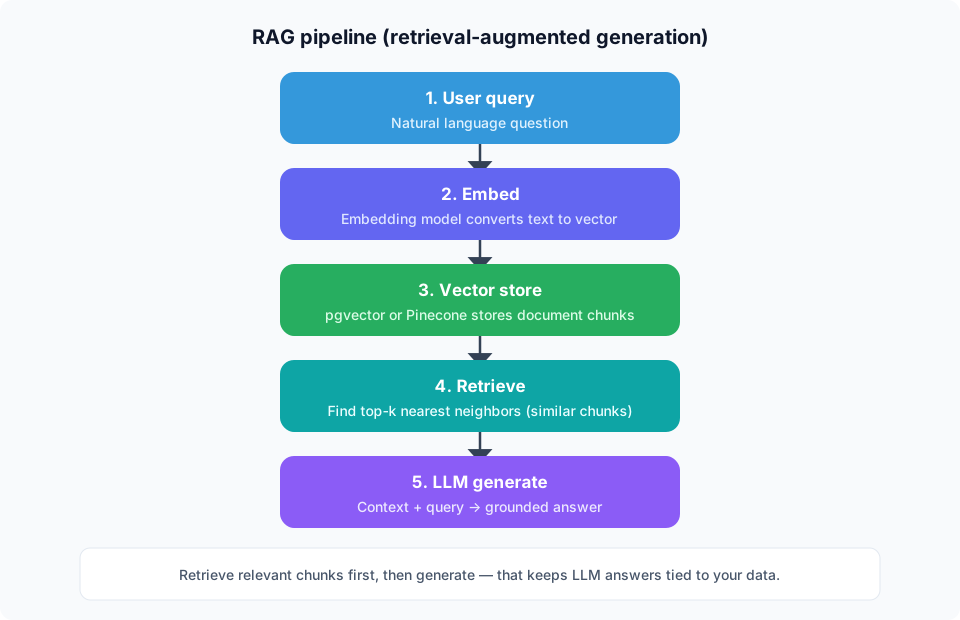
A vector is just an array of numbers that captures meaning. An embedding model turns a piece of text, or an image, or a clip of audio, into something like a 1,536 number array. Similar meanings produce similar arrays, so searching for the nearest neighbors of a query returns content that is semantically related. That is the whole trick, and a vector database exists to do it quickly at scale.
What pgvector and Pinecone actually are
These two tools come from two different philosophies, and understanding that split is most of the decision.
pgvector: vectors inside the database you already run
pgvector is a PostgreSQL extension. It adds a vector data type, distance operators, and index support to Postgres. If you already run Postgres, adopting it is a single migration:
CREATE EXTENSION IF NOT EXISTS vector;

      CREATE TABLE documents (
          id          BIGSERIAL PRIMARY KEY,
          title       TEXT NOT NULL,
          content     TEXT NOT NULL,
          user_id     BIGINT REFERENCES users(id),
          created_at  TIMESTAMPTZ NOT NULL DEFAULT NOW(),
          embedding   vector(1536)
      );

      CREATE INDEX ON documents
          USING hnsw (embedding vector_cosine_ops);
Your embeddings live in the same table as the rest of your data. No new service to run, no new API key, no extra network hop, no separate bill.
Pinecone: a managed service built only for vectors
Pinecone is a hosted vector database tuned specifically for vector workloads at large scale. You send vectors to its API and it handles the indexing, sharding, replication, and scaling for you. There is no cluster to babysit and no Postgres tuning to learn. The cost of that convenience is duplication. Your documents live in your primary database while your embeddings live in Pinecone, so you end up maintaining two stores for what is really one entity, and you pay both per vector and per query.

Comparing them side by side
| Dimension | pgvector | Pinecone |
|---|---|---|
| Architecture | Extension inside PostgreSQL | Separate hosted service |
| Operational overhead | Inherits your existing Postgres ops | None, fully managed |
| Cost model | Whatever your Postgres instance costs | Per vector storage plus per query fees |
| Best scale | Up to about 50 million vectors on one strong node | 100 million and beyond with steady latency |
| Filtering and joins | Native SQL, filter and join and scope in one query | Metadata filtering with real limits |
| Single source of truth | Yes, vectors and relational data together | No, two stores to keep in sync |
| Latency under 1 million vectors | 5 to 20 milliseconds with HNSW at 95 percent recall | Single digit to low double digit milliseconds |
| Tuning at large scale | Needs HNSW tuning past 100 million | Holds recall without tuning |
| Licensing | Open source, PostgreSQL License | Proprietary, hosted only |
The single most important row there is filtering and joins, so let us spend a moment on it.
The SQL advantage that decides most RAG projects
Picture a RAG pipeline where retrieval has to filter by user, by document type, and by date range, then rank by similarity, then join the result against a permissions table to confirm the person is even allowed to see each chunk.
With pgvector, that is one query:
SELECT d.id, d.title, d.content
      FROM documents d
      JOIN permissions p ON p.document_id = d.id
      WHERE d.user_id = $1
        AND d.doc_type = 'contract'
        AND d.created_at > NOW() - INTERVAL '90 days'
        AND p.role = ANY($2)
      ORDER BY d.embedding <=> $3
      LIMIT 10;
With Pinecone, the same logic means leaning on metadata filtering, which has improved but still hits expressiveness limits, plus joining against your primary database in application code. As the engineers at Rivestack put it in their own breakdown, the moment your retrieval starts to look like vector search plus business logic, pgvector's ability to express all of it in one SQL statement becomes a real advantage. For anything that scopes results by user, organization, or document status, this row alone tends to settle the question.
Performance is closer than the arguments suggest
There is a stubborn myth that pgvector is the slow option. In 2026 that is simply not true anymore.
The team at Encore, in their hands on comparison, measured pgvector with an HNSW index answering queries over 1 million vectors in roughly 5 to 20 milliseconds at 95 percent recall or better, with the result depending mostly on how large your Postgres instance is. They also made the point that reframes this whole debate: in a RAG pipeline, the vector search is almost never the slow part. The gap in search latency between pgvector and Pinecone is smaller than the time it takes to call the embedding API before the search, and far smaller than the language model generation that comes after it. Optimizing the fastest step in your pipeline is rarely where the real wins are hiding.
Scale changes the picture, though. Around 1 million vectors, both tools reach 95 percent recall on default settings. Push toward 100 million and Pinecone holds its recall without tuning, while pgvector starts to ask you for careful HNSW parameter work. The practical ceiling for pgvector is the limit of a single Postgres node, somewhere near 50 million vectors on a well provisioned instance, rather than anything wrong with the extension itself. Supabase, Neon, and Instacart all run pgvector in production at meaningful scale, and Tiger Data's pgvectorscale add on pushes that ceiling considerably further, reporting strong recall and throughput well past the point where a plain single node would struggle.
Cost is where the gap gets real
pgvector costs whatever your PostgreSQL instance costs. If you already run Postgres for your application, adding vectors is close to free at the margin. It is a new column and an index on hardware you are already paying for.
Pinecone, by contrast, bills you per vector for storage and per query for traffic. When the engineers at JustSoftLab ran a production benchmark on a legal document system with tens of millions of chunks, and when the team at Kalvium Labs compared the options across more than ten production RAG systems, both landed on a similar figure: Pinecone tends to run somewhere between three and eight times the cost of a comparable managed Postgres instance at the same vector count for workloads in the low millions. That premium can absolutely be worth it. Zero operations has genuine value when infrastructure headaches are not how you want your team spending its week. The point is to choose it on purpose rather than by accident.
The honest framing is this. At small to mid scale, you are mostly paying Pinecone for operational simplicity, not for speed. Decide what that simplicity is worth to you before you sign up for a recurring per vector bill.
When to use each
Reach for pgvector when
You already run PostgreSQL, especially on a managed provider. You sit under roughly 10 to 50 million vectors. Your retrieval needs real filtering, joins, or scoping by user or tenant. You want a single database as your source of truth. Cost and data sovereignty matter to you. And you would rather stay on open source infrastructure than a proprietary, hosted only product.
Reach for Pinecone when
You are operating at hundreds of millions of vectors. You need steady high query throughput with predictable latency at that scale. You require multi region replication out of the box. Your use case is mostly pure vector search with very little relational data, joins, or filtering. Or your team simply wants no database operations at all and will pay a premium to keep it that way.
A clean tiebreaker comes from the way the writers at Kunal Ganglani's blog framed it. If your data is really just vectors with a few tags attached, you lose almost nothing by giving up SQL, and Pinecone's architecture maps neatly onto your problem. The more your retrieval looks like vectors tangled up with business logic, the harder pgvector pulls ahead.
Adding vector search to Postgres in five steps
If you land on pgvector, here is the practical path from nothing to a working retrieval query.
First, enable the extension.
CREATE EXTENSION IF NOT EXISTS vector;Second, add an embedding column sized to your model. OpenAI's text-embedding-3-small produces 1,536 dimensions, while text-embedding-3-large produces 3,072.
ALTER TABLE documents ADD COLUMN embedding vector(1536);Third, generate embeddings for your existing rows by sending their content through your embedding model and writing the result back into that column.
Fourth, build an HNSW index so nearest neighbor search stays fast.
CREATE INDEX ON documents USING hnsw (embedding vector_cosine_ops);Fifth, query by similarity and fold in ordinary SQL filters at the same time.
SELECT id, title
      FROM documents
      WHERE user_id = $1
      ORDER BY embedding <=> $2
      LIMIT 5;
That gives you a retrieval layer ready for production, running on infrastructure you already operate.
Frequently asked questions
Is pgvector ready for production in 2026?
Yes. The 0.7 release series and later brought parallel index builds, faster HNSW performance, and better memory management. Supabase, Neon, and Instacart run it in production at significant scale. The thing that limits it is the capacity of a single Postgres node, not the maturity of the extension.
Do I actually need a dedicated vector database for RAG?
For most applications under a few million documents, no. If you already run PostgreSQL, pgvector handles RAG retrieval well and keeps everything in one place. A dedicated vector database starts to earn its keep mainly at very large scale or for workloads that are nothing but vectors.
Does pgvector or Pinecone produce better RAG answers?
At the same recall level, both produce equivalent output quality. The thing that drives answer quality is your embedding model, your chunking strategy, and the language model itself, not the store you pull vectors from. The store's only job is to hand back the right neighbors quickly. Where they differ is how much work it takes to hit a given recall level at your scale.
What happens past 50 million vectors?
A single Postgres node starts to strain somewhere around there. At that point you either reach for pgvectorscale, shard your data, or seriously evaluate a purpose built system. Once you are past 100 million vectors with steady high query traffic, Pinecone's architecture has a clear edge.
Can I start on pgvector and move later if I have to?
Yes, and it is a sensible default. Most teams never reach the scale where a migration becomes necessary. Starting on pgvector costs you almost nothing if you are already on Postgres, and your embeddings stay portable if the day ever comes that you need to move them.
Where BuildSpace fits
This whole decision gets simpler when your PostgreSQL is already managed for you.
BuildSpace gives you managed PostgreSQL with direct database access, automated backups, and high availability. That means turning your database into a production vector store is one CREATE EXTENSION vector away. You get vector search, relational data, filtering, and joins in a single place, with the operational side handled for you. And because BuildSpace Studio can generate REST and GraphQL APIs over that same database, the retrieval layer for your RAG app comes together without you hand writing CRUD servers.
For the large group of teams whose answer to the pgvector or Pinecone question is pgvector, which is to say most teams building AI applications this year, a managed Postgres that ships with vectors, APIs, and backups takes care of most of the friction that is left.
Key takeaways
- pgvector is the right default for most AI applications in 2026, especially if you already run Postgres and stay under roughly 10 to 50 million vectors.
- Pinecone wins at extreme scale, past 100 million vectors, and when you need steady high throughput, multi region replication, or pure hands off operations.
- Performance is closer than the debate implies. Vector search is rarely the bottleneck in a RAG pipeline, since the embedding call and the language model generation dominate the time.
- pgvector's ability to filter, join, and scope inside one SQL query is its biggest practical advantage for real RAG systems.
- Cost favors pgvector at small to mid scale, where you are mostly paying Pinecone for operational simplicity. That can still be worth it, as long as you choose it deliberately.
- You can start on pgvector and migrate later, and most teams never need to.
- Answer quality comes from your embedding model, your chunking, and your language model, not from which vector store you pick.
Sources & citations
- The team at Encore on latency and the point that vector search is rarely the RAG bottleneck: Encore, pgvector vs Pinecone
- Groovyweb on market size and pgvector's production credibility at Supabase, Neon, and Instacart: Groovyweb, vector database comparison 2026
- JustSoftLab's production benchmark to 50 million vectors on cost and query flexibility: JustSoftLab, Postgres and pgvector vs Pinecone
- Kalvium Labs across more than ten production RAG systems on cost multiples and defaults: Kalvium Labs, vector databases compared
- Rivestack on the vector search plus business logic framing: Rivestack, pgvector vs Pinecone
- Kunal Ganglani on SQL filtering and the just vectors with tags tiebreaker: Kunal Ganglani, pgvector vs Pinecone
- Tiger Data on pgvectorscale performance: Tiger Data, pgvector vs Pinecone
Building a RAG app and want vector search without standing up a second database? BuildSpace gives you managed PostgreSQL, with vectors, relational data, and auto generated APIs in one place. Learn more at buildspace.site
About BuildSpace: BuildSpace is cloud infrastructure for the AI era. Managed PostgreSQL, auto generated REST and GraphQL APIs, and transparent pricing. One database, one source of truth, ready for whatever you are building.